National Hotline
+86-0516-87631319
+86-0516-87631319
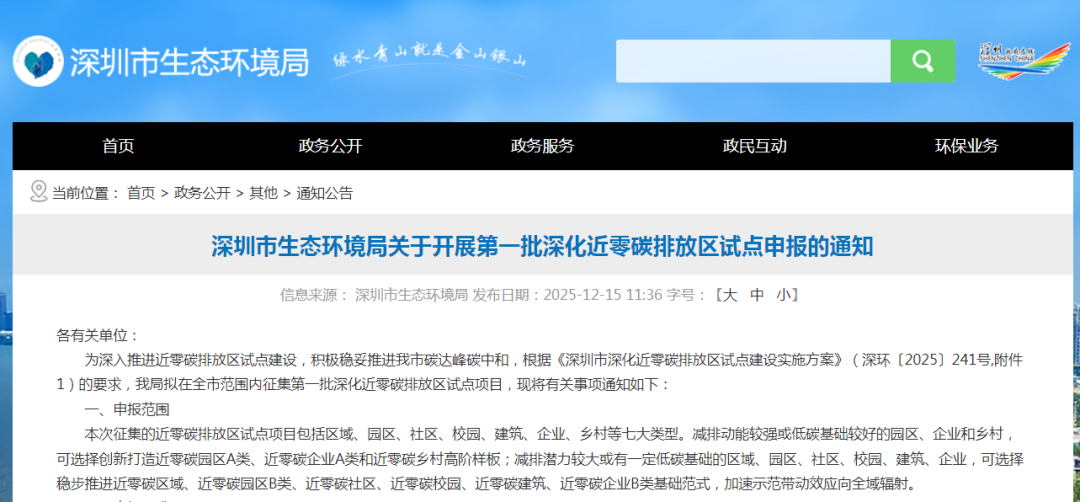
On December 15, the Shenzhen Municipal Bureau of Ecology and Environment in Guangdong Province issued a notice on the application for the first batch of pilot projects to deepen near-zero carbon emission zones. The pilot projects for near-zero carbon emission zones include seven major types: regions, industrial parks, communities, campuses, buildings, enterprises, and rural areas. Industrial parks, enterprises, and rural areas with strong emission reduction momentum or a solid low-carbon foundation may opt to innovate and establish high-end models such as near-zero carbon industrial parks (Category A), near-zero carbon enterprises (Category A), and near-zero carbon villages. Regions, industrial parks, communities, campuses, buildings, and enterprises with significant emission reduction potential or a certain low-carbon foundation may choose to steadily advance basic models like near-zero carbon regions, near-zero carbon industrial parks (Category B), near-zero carbon communities, near-zero carbon campuses, near-zero carbon buildings, and near-zero carbon enterprises (Category B), accelerating the demonstration effect to achieve full-scale radiation.
The *Implementation Plan for Shenzhen's Pilot Construction of Near-Zero Carbon Emission Zones* states that among the primary indicator system for near-zero carbon emission zone pilots, there must be at least one application scenario for zero-carbon energy. This indicator is reflected by counting the actual number of different types of zero-carbon energy technology solutions implemented in pilot projects, including but not limited to: waste heat, waste cooling, and waste pressure综合利用, new energy storage, fuel cells, load demand response (virtual power plants), and microgrids.
The proposed construction pathway mentions that the energy sector primarily includes energy demand forecasting, energy supply optimization technologies such as renewable energy utilization, efficient and clean utilization of fossil fuels, distributed energy technologies, and agricultural/fishery-solar complementary technologies, as well as energy storage and transmission technologies like advanced energy storage and smart grid technologies, along with energy efficiency technologies such as waste heat recovery, direct green power supply, and green power purchasing.
Mobile phone:+86-0516-87631319
Phone:+86-15651461419
Mailbox:3966142672@qq.com
Address: No. 20 Zhenxing Avenue, Xuzhou Economic and Technological Development Zone, Jiangsu Province